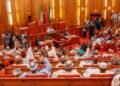
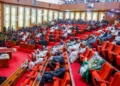
After days of intense debate, the Nigerian Senate has formally passed the Electoral Act (Repeal and Re-enactment) Bill, 2026 into law, retaining a provision that allows electronic transmission of election results but discarding the mandatory real-time transmission requirement.
Tuesday’s historic passage follows dramatic legislative action, heated arguments, and procedural maneuvers spanning from yesterday’s closed-door deliberations to today’s final plenary session.
The final reenacted version of Clause 60 which is the bone of contention reads thus;
Clause 60, governing counting and transmission of votes, became the flashpoint of debates, particularly subsection (3), which reads:
“(3) The Presiding Officer shall electronically transmit the results from each polling unit to the IREV portal, and such transmission shall be done after the prescribed Form EC8A has been signed and stamped by the Presiding Officer and/or countersigned by the candidates or polling agents where available. Provided that if electronic transmission fails due to communication failure, Form EC8A shall remain the primary source of collation and declaration of the result.”
The provision sparked fierce disagreement over the role of manual collation in areas with poor network coverage.
During Tuesday’s plenary, Senator Enyinnaya Abaribe (PDP, Abia South) called for a division under Order 72, challenging the proviso.
The resulting vote saw 55 senators in favor, including APC members and three minority lawmakers Olalere Oyewumi (PDP, Osun), Wadada Aliyu (SDP, Nasarawa), and Amos Yohanna (PDP, Adamawa) while 16 senators voted against, opposing reliance on manual procedures.
Legislative Rescission and Reconsideration
The final passage followed a dramatic reopening of the Electoral Act for amendment. On Tuesday, the Senate debated a motion to rescind its February 10, 2026 passage of the Bill due to concerns that the 2027 general elections might coincide with the Ramadan fasting period.
Sponsored by Senator Michael Opeyemi Bamidele (Ekiti Central), the motion sought to recommit the legislation to the Committee of the Whole for technical corrections and timeline adjustments. Key objectives included:
Rescheduling the 2027 elections to February 13 instead of February 20 to avoid Ramadan.
Correcting discrepancies across multiple clauses, including Clauses 1(d), 10, 22, 23, 28, 29, 32, 42, 47, 51, 60, 62, 64, 65, 73, 77, 86, 87, 89, 93, and 143.
Harmonizing electronic transmission provisions to ensure integrity while accommodating network limitations.
Dramatic Repeal and Clause-by-Clause Reenactment
Under Order 52(6) of the Senate Standing Rules, the Senate, sitting as Committee of the Whole, repealed Clauses 1–156 of the 2022 Electoral Act and commenced clause-by-clause reenactment.
Senator Simon Lalong, Chairman of the Senate Committee on Electoral Matters, explained that while the framework supports electronic transmission of results to INEC’s IReV portal, a manual backup safeguard ensures transparency in areas with poor network coverage.
“The goal of this amendment is to strengthen our democratic process, enhance transparency, and restore the confidence of the Nigerian people in our electoral system,” Lalong said.
Stalled Harmonisation and House Walkout
The legislative journey was further complicated by delays in the Conference Committee harmonisation meeting, which ended in deadlock on Monday due to the absence of key House members. The most contentious issue remained Clause 60(3).
Tensions escalated in the House of Representatives, where members staged a dramatic walkout from a closed-door session, shouting “Ole APC”, accusing the ruling party of undermining the previously agreed real-time transmission provision.
The House had originally mandated real-time uploads of results to the IReV portal. Efforts by some APC lawmakers to align the House provision with the Senate’s more flexible framework sparked the protest.
The Electoral Act 2026 now provides:
Electronic transmission of results from polling units, with Form EC8A serving as the official record.
Manual collation as the primary source where electronic transmission fails.
Adjusted timelines for the 2027 elections to avoid clashes with Ramadan.
This legislative intervention is widely regarded as a significant step in shaping the framework for Nigeria’s 2027 general elections, balancing technological efficiency with practical safeguards for areas with infrastructural limitations.
This report will be updated with further reactions from lawmakers, INEC, and civil society groups as they respond to the final passage.