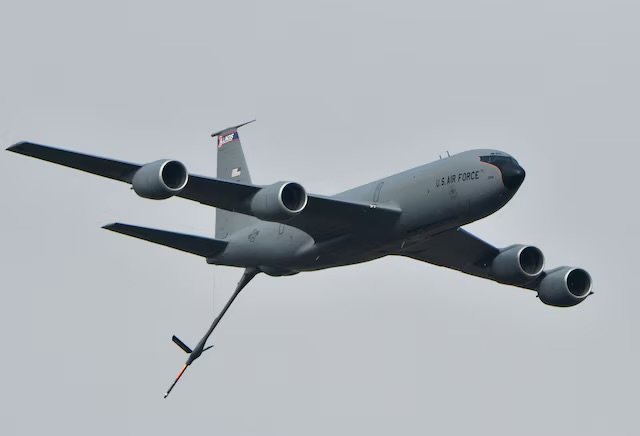
Four service members died after a U.S. Air Force refueling aircraft crashed in Iraq on Thursday while supporting operations in Iran, military officials said.
Rescue efforts were still underway for the remaining two crew members, U.S. Central Command said, after an apparent mid-air accident between two U.S. Air Force KC-135 tanker aircraft.
“The circumstances of the incident are under investigation,” it said, adding that the identities of the service members would be withheld for 24 hours while next of kin were notified.
Centcom disclosed the incident in western Iraq in a brief statement on Thursday, saying the second aircraft landed safely and that the crash “was not due to hostile fire or friendly fire.”
Three officials, speaking on the condition of anonymity to discuss the sensitive situation, said the second aircraft was also a KC-135.
The KC-135 Stratotanker carries a minimum crew of three — a pilot, co-pilot and boom operator, the person responsible for overseeing the aircraft refueling other planes. It can also carry a navigator or other additional crew members, depending on the mission.
Refueling aircraft have been in high demand since the start of the Trump administration’s war with Iran on Feb. 28. Over the past two weeks, U.S. forces have carried out relentless airstrikes against more than 6,000 targets, including ballistic missile sites, Iranian air defenses and weapons productions facilities.
Aerial refueling is one of the most complex military missions — but also one of the most critical due to the limited amount of fuel that fighter jets can carry and how quickly they run through their tanks.
When fighters are tasked with conducting strikes, tankers are often in the air as support. Once a refueling mission begins, tanker pilots have to maintain the massive refueler in steady flight and hold a close distance as the operator in the back of the plane controls the boom with a joystick, slowly lowering it toward an approaching plane.
It is inherently dangerous, and there have been multiple accidents over the years in which an incorrect approach resulted in damage or death, including a U.S. Marine Corps incident in Japan in 2018 where an F/A-18 aircraft collided with a C-130 tanker during a refueling mission, killing six.
Open source flight tracking data reviewed by The Post indicates that U.S. KC-135 refueling runs on Thursday left from Israel’s Ben Gurion Airport. Only one did not return, according to the records.
A different KC-135 that had taken off from Ben Gurion returned to Israeli airspace around 7:15 p.m. local time, transmitting a four-digit code, also knowing as “squawking,” that indicated it was experiencing an emergency. It circled off the coast for around an hour before landing at Ben Gurion at 8:35 p.m.
A photo posted on Facebook Thursday evening by flight-tracking enthusiasts purported to show the KC-135 that had landed safely with part of its vertical stabilizer, or tail fin, missing. Several features of the aircraft matched publicly available photographs of the same military tanker that had landed at Ben Gurion Airport broadcasting the emergency code. The Post could not independently verify the photo or identify the individual who took it.
The KC-135 crash was the second adverse incident reported by U.S. military officials Thursday. Earlier in the day, the Navy said that another key asset in the ongoing war against Iran, the aircraft carrier USS Gerald R. Ford, experienced an onboard fire in its main laundry area resulting in “non-life-threatening injuries” to two sailors.
Seven American service members have died due to hostile fire since the Iran war began last month.
Six fatalities resulted from an attack at a port in Kuwait on March 1. An Iranian drone struck an operations center there, officials said, killing and wounding troops who did not have overhead protection from aerial threats.
Another U.S. service member who was wounded in a separate attack in Saudi Arabia on March 1 died a week later from his injuries.
Three Air Force F-15E Strike Eagles were shot down mistakenly by Kuwaiti forces in “an apparent friendly fire incident” that occurred during the war’s opening stages.
More than 50,000 American troops are deployed in support of U.S. and Israeli operations against Iran, including almost every type of warplane in the Air Force fleet.
(Washington Post)