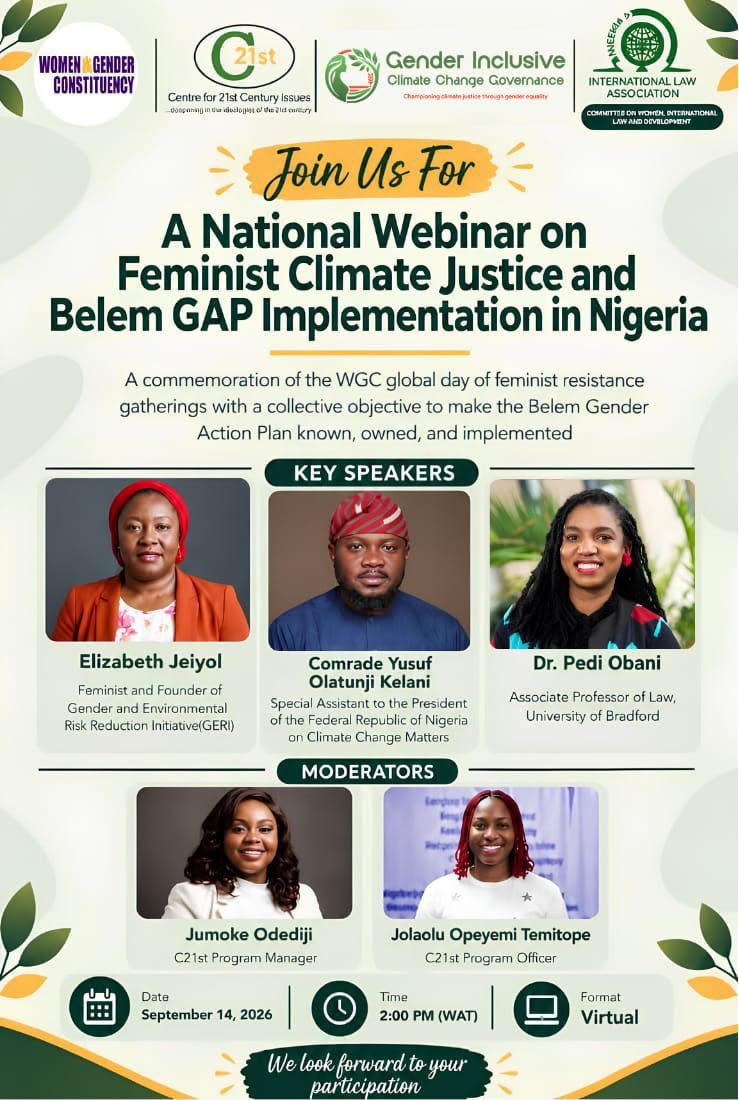
Experts have called for stronger implementation of the Belem Gender Action Plan, improved access to climate finance and greater participation of women and vulnerable groups in climate-related decision-making.
The call was made on Monday during a virtual dialogue on feminist climate justice and implementation of the Belem Gender Action Plan (GAP), organised by the Women & Gender Constituency, Centre for 21st Century Issues, Gender Inclusive Climate Change Governance, and ILA Committee on Women, International Law and Development.
The webinar was also held as part of the commemoration of the Women’s Global Connection (WGC) Global Day of Feminist Resistance gatherings, with participants united around the collective objective of making the Belem Gender Action Plan known, owned and effectively implemented.
In her welcome address, Executive Director of the Centre for 21st Century Issues, Titi Akosa, said women and girls remained at the forefront of the global response to climate and environmental challenges, describing the adoption of the Belem Gender Action Plan as a significant milestone.
Akosa said the plan provides an international framework for mainstreaming gender equality into environmental laws, national development strategies and decision-making processes.
She said the webinar was aimed at translating global policy commitments into practical action at the local level.
According to her, the discussions would explore practical ways to implement the Belem Gender Action Plan, uphold human rights standards and ensure that Nigerian women were not only protected under the framework but also empowered to take leadership roles in building a sustainable future.
The discussion brought together climate and gender experts, including Yusuf Olatunji Kelani, Special Assistant to the President on Climate Change Matters; Associate Professor of Law at the University of Bradford, Dr Padi Obani; and feminist and environmental geographer, Elizabeth Jeiyol.
Kelani said Nigeria must move beyond climate commitments and focus on translating policies into practical action that produces measurable results for communities.
“Climate justice cannot be achieved without gender justice, and gender-responsive climate action cannot succeed without accountability,” he said.
He argued that women and young people should be active participants in shaping Nigeria’s climate future, rather than being treated merely as beneficiaries of climate interventions.
Kelani also called for the implementation of the Belem Gender Action Plan to extend beyond national institutions to state-level organisations, community groups, women leaders, traditional institutions and grassroots networks.
He said climate policies must recognise that women experience the effects of climate change differently depending on their location, livelihood, age, disability and socio-economic circumstances.
“The experience of a woman in Lagos is different from that of a woman farmer in Katsina, a fisherwoman in the Niger Delta, a woman environmental defender or a woman living with disability,” he said.
He urged policymakers to make consultation processes more accessible through local languages, virtual participation and measures that address financial and cultural barriers to women’s participation.
Kelani, however, said technology should complement, rather than replace, direct engagement with communities.
Associate Professor of Law at the University of Bradford, Dr Padi Obani, said the Belem Gender Action Plan provides an implementation framework for integrating gender considerations into climate governance.
She explained that the plan contains 27 activities and 98 deliverables grouped under five priority areas, including capacity building, knowledge management and communication; gender balance and women’s leadership; policy coherence; gender-responsive implementation and means of implementation; as well as monitoring and reporting.
According to her, the framework is important because climate vulnerability differs across communities and women should not be viewed solely as victims of climate change.
She said women farmers, entrepreneurs, community organisers and other grassroots actors also contribute to climate adaptation and resilience.
Obani warned against concentrating climate policy discussions in major cities, saying this could exclude communities most affected by climate change.
She called for the implementation and review of the Belem Gender Action Plan to involve community organisations, traditional institutions, women leaders and other grassroots networks.
On her part, Elizabeth Jeiyol, a feminist and environmental geographer and development practitioner, said climate change was not gender-neutral because existing inequalities affect women’s ability to respond to its consequences.
She identified unequal access to land, finance, healthcare, technology, information and political decision-making as factors that can worsen the impact of climate change on women.
According to her, water shortages, food insecurity, flooding, displacement, disruption of livelihoods and declining agricultural productivity can increase women’s domestic and unpaid care responsibilities.
Jeiyol urged policymakers to look beyond describing women as vulnerable and instead examine how climate-related events affect their homes, livelihoods, access to information, finances, land and participation in community decisions.
She also stressed the need to consider the experiences of rural women, displaced communities and other groups facing heightened climate risks.
She also highlighted the need for safe and meaningful participation for women involved in climate action and environmental defence.
Participants, however, called for funding mechanisms that would enable women-led organisations, community groups and grassroots initiatives to directly access climate finance.
They warned that without accessible funding, gender-responsive climate policies could remain largely on paper without producing meaningful improvements in vulnerable communities.
The experts further urged the government and development partners to strengthen monitoring and accountability, improve gender-disaggregated data and support women-led climate initiatives.
They said the success of Nigeria’s climate policies should ultimately be measured by whether they improve resilience, economic opportunities and the decision-making power of communities most affected by climate change.