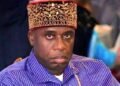
The Minister of the Federal Capital Territory (FCT), Nyesom Wike, has criticised former Rivers State Governor Rotimi Amaechi over his prediction that former Vice-President Atiku Abubakar could win the 2027 presidential election.
Wike questioned Amaechi’s political strength, claiming that fewer than 200 people attended a town hall meeting he held in Cross River State.
The minister made the remarks during his media chat on Tuesday while responding to a question about whether the emerging opposition alliance involving Atiku and Amaechi could threaten President Bola Tinubu’s chances in the next election.
Wike said Amaechi had based his prediction on the regional backgrounds of the leading presidential contenders, arguing that Atiku’s northern origin gave him an advantage over candidates from the South.
“I watched Amaechi. He had a town hall meeting in Cross River. I can tell you the numbers were not up to 200 people,” Wike said.
According to Wike, Amaechi told the gathering that Atiku was from the North, while Tinubu, the Labour Party’s 2023 presidential candidate, Peter Obi, and former governor Donald Duke were from the South.
Wike questioned how Amaechi arrived at the conclusion that Atiku had already won the next election based on this regional calculation.
“How can a vice-presidential candidate go to a town hall meeting, stand and tell his supporters, ‘Do you know how this election has been won?’” he asked.
The FCT minister also challenged the assumption that Atiku’s northern support base would automatically give him an advantage in the 2027 presidential race.
He pointed to the 2023 election, when Atiku and Obi lost to Tinubu despite the candidates’ regional backgrounds.
“In 2023, Atiku ran, Obi ran, Tinubu ran. Who won?” Wike asked.
Tinubu won the 2023 presidential election, while Atiku came second and Obi finished third.
However, Wike warned that the outcome of the previous election should not be taken as a clear indication of what would happen in 2027.
“I have always told you people, 2027 will be totally different from 2023,” he said.
The comments reflect growing political disagreements over the strength of opposition alliances and the role regional voting patterns could play in determining the outcome of the 2027 presidential election.